
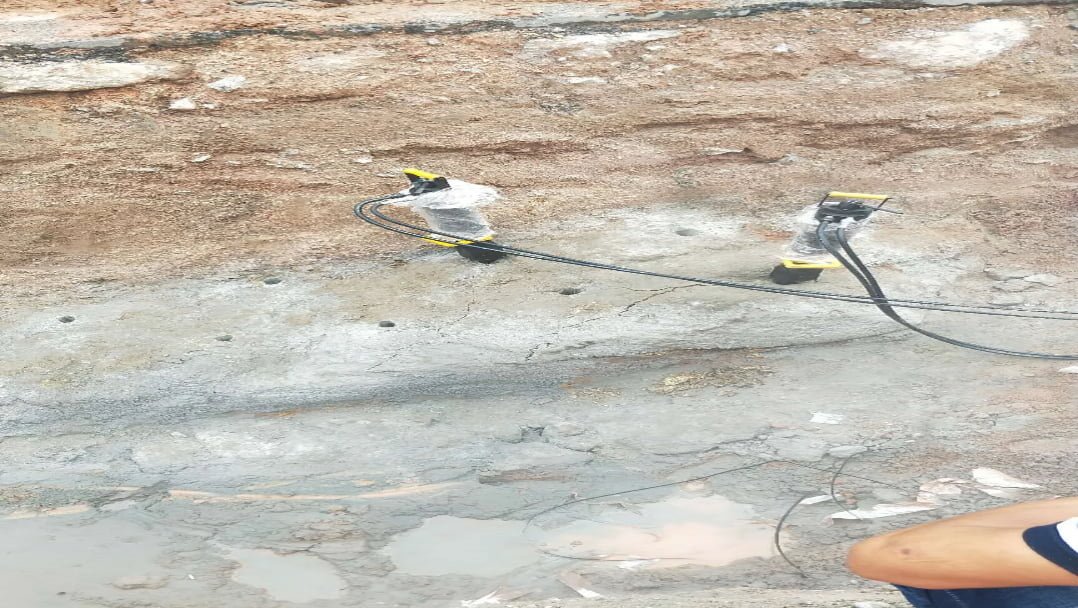
For Hydraulic Rock Splitter, What is its Rock Splitting Method?
What is the Rock Splitting Method?
Struggling with breaking hard rock for your mining or construction project? Traditional methods like explosives are often loud, dangerous, and create uncontrollable flyrock, leading to project delays and safety hazards.1 You need a more precise, controlled, and efficient way to get the job done without the associated risks. The rock splitting method offers a powerful, silent, and non-explosive solution, leveraging immense hydraulic force to break even the toughest rock from the inside out.
The rock splitting method is a controlled demolition technique that uses a hydraulic tool, called a rock splitter, to break large rocks or concrete. It works by inserting a wedge system into a pre-drilled hole and applying immense hydraulic pressure, causing the rock to fracture along a predetermined line due to its low tensile strength.
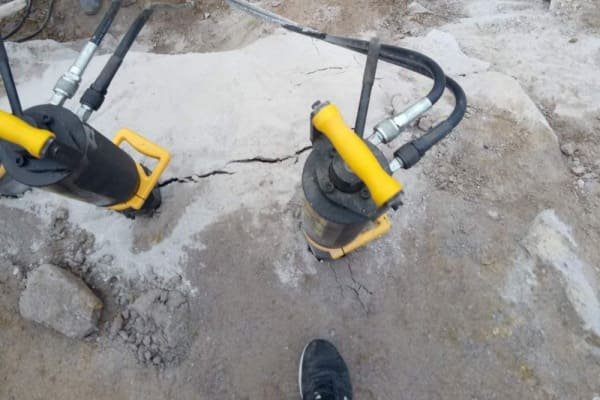
Now that you understand the basic definition, you're probably curious about the science behind it and how you can apply it on your job site. Let's dive deeper into the mechanics, the step-by-step process, and the critical best practices that ensure maximum efficiency and safety.
How Does the Hydraulic Rock Splitter Work?
Trying to break rock with brute force from the outside seems logical, but it’s highly inefficient. This approach forces you to fight against the rock's greatest natural property: its compressive strength. What if you could flip the script and attack its biggest weakness instead?
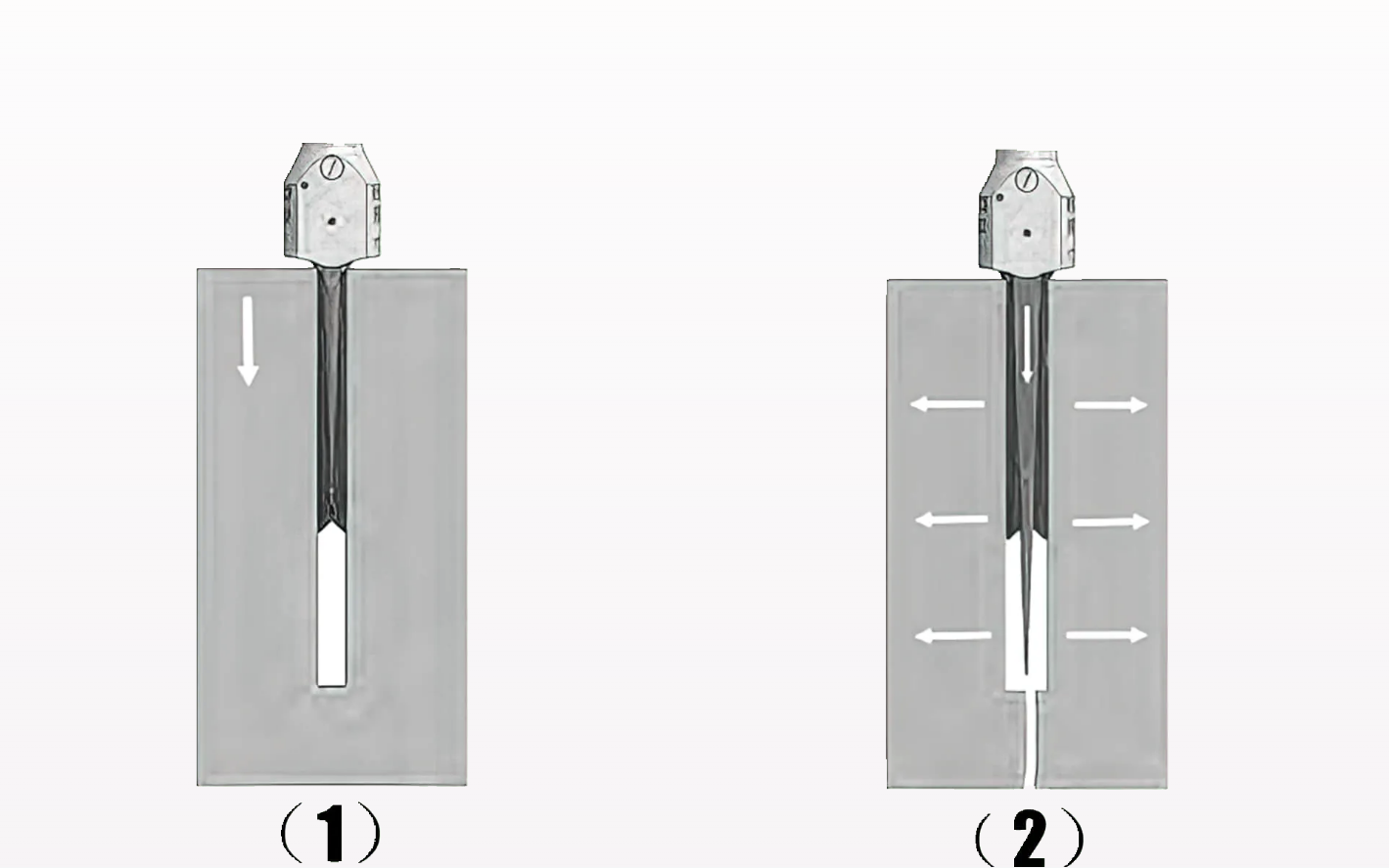
The hydraulic rock splitting method works by exploiting the fundamental properties of rock: high compressive strength but very low tensile strength. A hydraulic splitter exerts immense outward pressure from within a pre-drilled hole, easily overcoming the rock's tensile resistance and causing a clean, controlled break.
The Science: Compressive vs. Tensile Strength
Think about a concrete sidewalk. You can stand on it, drive a car on it, and it holds up perfectly. This is its compressive strength—its ability to resist being squeezed or pushed together. However, if you were to somehow pull that same slab of concrete apart from both ends, it would snap with relatively little effort. This is its tensile strength—its ability to resist being pulled apart.
Rock behaves in the exact same way. Its tensile strength is often just 5-10% of its compressive strength.2 The rock splitting method is engineered specifically to take advantage of this weakness. Instead of hammering or blasting the rock from the outside (fighting its compressive strength), the splitter attacks it from the inside, pulling it apart and exploiting its low tensile strength.
The Mechanics of a Hydraulic Rock Splitter
The system consists of three main parts:
- A hydraulic power pack (or pump station) that generates the high-pressure fluid.
- High-pressure hoses to deliver the fluid.
- The splitter cylinder, which is the handheld tool that goes into the rock.
Inside the splitter cylinder is a piston and a crucial component called a wedge set. This set includes one central, tapered wedge and two counter-wedges that rest against it.
Here’s how it works in sequence:
- The operator activates the hydraulic power pack, which sends high-pressure oil (typically around 60 MPa) through the hoses to the splitter.3
- This pressure drives the internal piston forward, which in turn forces the central wedge between the two counter-wedges.
- As the central wedge moves forward, it pushes the counter-wedges outwards with incredible force, pressing them against the inner walls of the pre-drilled hole.
- This outward expansion generates splitting forces of 400 to 700 tons. This force is more than enough to overcome the rock's tensile strength, and a fracture appears within seconds.
This process is a massive leap forward from old manual methods, which involved drilling a hole and laboriously hammering in wedges and shims.
| Feature | Manual Splitting (Wedge & Shims) | Hydraulic Rock Splitting Method |
|---|---|---|
| Power Source | Sledgehammer / Manual Labor | Hydraulic Pump |
| Splitting Force | Low | Extremely High (400-700 tons) |
| Speed | Very Slow (minutes to hours per split) | Very Fast (seconds per split) |
| Labor Intensity | High / Physically Demanding | Low / Operator Controlled |
| Control & Precision | Low | Very High |
| Safety | Risk of flying shims, physical strain | High (no flyrock, low vibration) |
What is the Step-by-Step Process for the Rock Splitter?
Knowing the theory is one thing, but applying it safely and effectively on a job site is another. A single mistake in the process can lead to inefficiency, equipment damage, or a poor break. Following a systematic procedure is key to success.
The process for the rock splitting method involves three main steps: drilling holes to the correct specifications, inserting the splitter's wedge set aligned with the desired break line, and activating the hydraulic pump to apply pressure until the rock fractures.
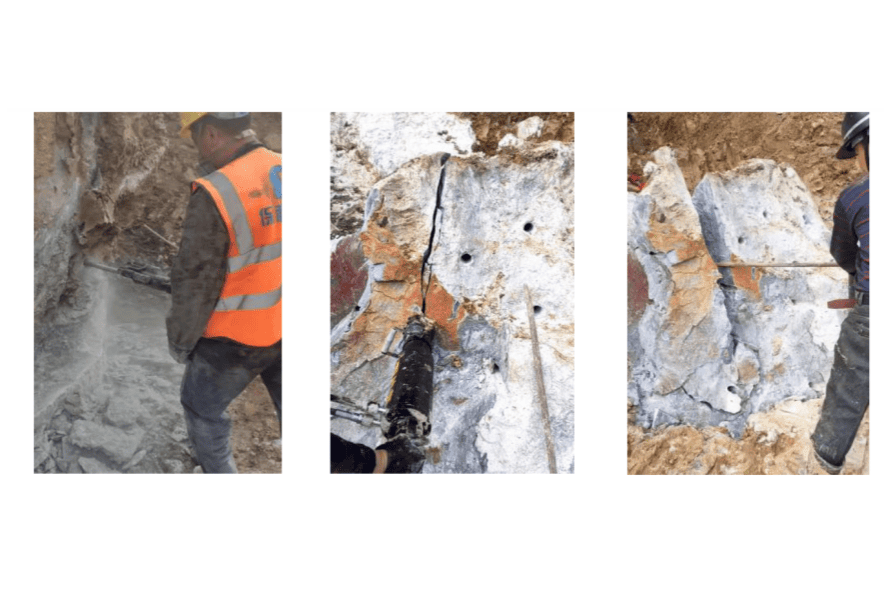
Step 1: Drilling and Hole Preparation
This first step is the foundation for the entire operation. Getting the drilling wrong will compromise everything that follows.
- Drill to Spec: You must use a rock drill to create a hole of the precise diameter and depth required for your specific model of rock splitter. If the hole is too large, the splitter's wedges won't make proper contact. If it's too small, the tool won't fit. The depth must be sufficient to accommodate the full length of the wedge set.
- Plan the Pattern: For large rock masses or trenching work, you'll need to drill a series of holes. The spacing between these holes depends on the type of rock and the size of the pieces you want to create.4 A well-planned pattern ensures the fractures connect and the rock is broken efficiently.
- Clean the Hole: After drilling, use compressed air to blow out all dust and debris from the hole. A clean hole ensures the splitter can be inserted smoothly and the wedges make solid contact with the rock wall.
Step 2: Splitter Placement and Alignment
This is the most critical step for achieving a controlled break. I've seen crews struggle because they ignored this simple rule.
- Align with the Free Face: Identify the "free face" of the rock—an open side where the rock has room to break away. The goal is to orient the splitter so that the force is directed towards this free face.
- Position the Wedges Correctly: The splitter tool will have an indicator showing the direction of the splitting force (the direction the counter-wedges push outwards). You must ensure this direction is parallel to your desired split line or free face. Imagine you're splitting a log with an axe—you always strike along the grain, not against it. It's the same principle. Proper alignment directs the force along the path of least resistance, giving you a clean break and preventing the tool from becoming pinched or stuck.5
Step 3: Hydraulic Activation and Splitting
With the splitter correctly in place, the final step is quick and satisfying.
- Engage the Pump: Start the hydraulic power pack.
- Apply Pressure: The operator uses a valve on the splitter's handle to start the splitting action. You will see the pressure gauge on the pump begin to rise as the central wedge moves forward.
- Listen for the Crack: Within a few seconds, you will hear a distinct "crack" as the rock's internal tensile strength is overcome and a fracture forms. The pressure gauge will then drop slightly.
- Retract and Repeat: Once the split is made, the operator reverses the valve to retract the wedge. The splitter can then be removed and placed in the next hole to continue the process. This cycle is repeated until the entire rock mass is broken into manageable pieces.
What are the Best Practices for Using the Rock Splitter?
You've invested in powerful equipment; now you want to maximize its lifespan and performance. Ignoring simple maintenance and operational rules can lead to costly downtime and repairs. A disciplined approach is essential for any professional operation.
Key best practices for the rock splitting method include using multiple splitters simultaneously to create a clear fracture line, regularly lubricating the wedge set to reduce wear, and carefully monitoring the hydraulic pressure to prevent it from exceeding the system's safety limit of 63 MPa.
The "Two-Point" Rule: Using Multiple Splitters
While one splitter can work, using two or more simultaneously is significantly more effective, especially in open-field splitting. Geometry tells us that two points define a line. By placing two splitters in adjacent holes and activating them at the same time, you create a perfectly defined fracture line between them. This offers two major advantages:
- Predictable Fractures: It guarantees the rock will split exactly where you want it to, giving you greater control over the size and shape of the broken pieces.
- Prevents Pinching: With a single splitter, the rock can sometimes fracture unpredictably and "pinch" the tool, making it difficult to remove. Using two splitters ensures the rock opens up along the intended line, releasing both tools easily. This small change in technique dramatically boosts efficiency and reduces potential frustration.
The Lubrication Imperative
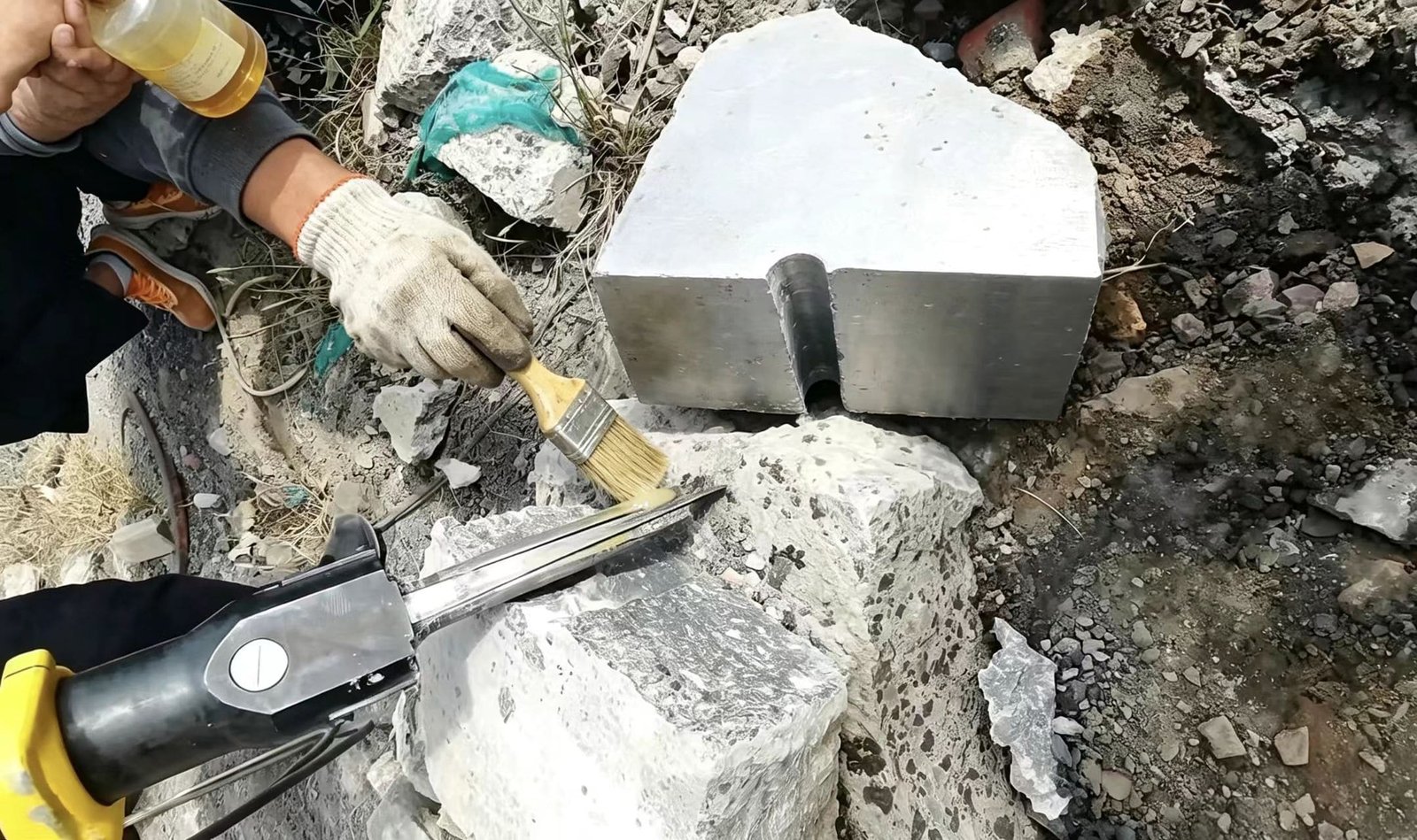
The wedge set of a rock splitter operates under immense friction and pressure. Neglecting lubrication is the fastest way to destroy this critical component. I once saw a new crew burn through a wedge set in half its expected lifespan simply because they forgot this step. A simple tube of grease could have saved them thousands.
- The Rule: After every 3 to 5 splits, retract the wedge and apply a liberal amount of suitable high-pressure grease to the entire wedge set.
- The Reason: This simple action does three things: it dramatically reduces friction and wear on the metal components, it helps dissipate heat, and it ensures the wedge travels smoothly for maximum splitting force. It's the single most important maintenance task you can perform.
Pressure Management: The 63 MPa Limit
Your hydraulic power pack is the heart of the operation, and its pressure gauge is your most important indicator. Our systems are designed to operate efficiently up to 60 MPa and have a safety limit of 63 MPa.
- Never Exceed the Limit: If you are splitting a particularly tough piece of rock and see the pressure gauge climb to 63 MPa, you must immediately stop and retract the wedge.
- Why is this critical? Pushing the system beyond its maximum pressure is known as "dead-heading." It puts an enormous strain on the pump, the hoses, and the seals. Most importantly, it can generate enough force to cause a catastrophic failure of the wedge set, potentially causing it to fracture.
- What to do instead: If you hit the pressure limit, retract the tool. The rock may be too hard, or the hole placement might be wrong. Re-evaluate, drill another hole nearby, and try again. Protecting your equipment is always cheaper than replacing it.
Frequently Asked Questions
How is this different from chemical demolition agents (expansive grout)?
The rock splitting method is much faster. A hydraulic split happens in seconds, whereas expansive grout can take many hours or even a full day to work.6 Hydraulic splitting is also reusable and less sensitive to temperature, while grout is a one-time use product that can be affected by ambient temperatures.7
Can the rock splitter be used underwater?
Yes, absolutely. Many hydraulic rock splitters, including models we offer, are designed to operate fully submerged. This makes them an ideal solution for port construction, harbor deepening, and bridge pier demolition where explosives are not an option.
What size rock can a splitter handle?
Virtually any size. The power of the rock splitting method lies in its scalability. For a massive boulder or a large rock ledge, the solution isn't a bigger tool—it's a better strategy. By drilling a pattern of holes, you can systematically break down any size rock mass into smaller, manageable sections.
Is the rock splitter noisy?
Compared to alternatives like hydraulic hammers or explosives, this method is remarkably quiet.8 The primary noise comes from the rock drill used to make the holes and the low hum of the hydraulic power pack. The actual splitting action is silent, apart from the sound of the rock cracking. This makes it perfect for use in urban areas or sensitive environments.
Conclusion
To sum up, the hyfraulic rock splitter is a modern, safe, and highly efficient technique for breaking rock and concrete without the dangers of blasting. It cleverly exploits the rock's inherent weakness—its low tensile strength—by applying immense hydraulic force from within a pre-drilled hole. The process is straightforward: drill, insert the tool correctly, and apply pressure. By following key best practices, such as using multiple splitters, maintaining a strict lubrication schedule, and managing hydraulic pressure, you can ensure a productive, safe, and cost-effective operation. This method provides the control and precision that modern mining and construction projects demand.
For purchasing managers, engineering contractors, and mine owners looking for a reliable, non-explosive rock breaking solution, this technology is the definitive answer. If you need robust, high-quality rock splitters, integrated drilling and splitting machines, or other rock breaking systems that comply with ISO 9001 and CE certification standards, we can help.
Contact Meiger Machinery today to discuss your project requirements and receive a customized quote for our world-class equipment.
"Mining Topic - Blasting and Explosives - NIOSH - CDC Archive", https://archive.cdc.gov/www_cdc_gov/niosh/mining/topics/Explosives.html. A government mine-safety or occupational-safety source documents flyrock, noise, vibration, and related injury risks as recognized hazards of blasting operations; this supports the article's general contrast with non-explosive methods, although it does not establish that blasting causes delays in every project. Evidence role: general_support; source type: government. Supports: Blasting operations can create recognized hazards such as flyrock, noise, vibration, and safety risks.. Scope note: Contextual support for the hazard comparison; project-delay effects would need project-specific evidence. ↩
"[PDF] strength properties of rocks and rock masses", https://ceae.colorado.edu/~amadei/CVEN5768/PDF/NOTES8.pdf. Rock-mechanics studies comparing tensile and compressive strength show that tensile strength is generally much lower than compressive strength and often falls within a low-percentage range, supporting the article's rule of thumb while recognizing that the exact ratio depends on lithology, defects, and test method. Evidence role: statistic; source type: paper. Supports: Published rock-mechanics literature reports that tensile strength is typically a small fraction of compressive strength, with ratios varying by rock type.. Scope note: The 5-10% range is a generalization and may not apply to every rock type or testing condition. ↩
"A preliminary qualitative evaluation of a hydraulic splitting cylinder ...", https://www.researchgate.net/publication/328599155_A_preliminary_qualitative_evaluation_of_a_hydraulic_splitting_cylinder_for_breaking_rock_in_deep-level_mining. Technical literature or equipment-test documentation reporting hydraulic splitter operating pressures near 60 MPa would substantiate the article's pressure figure, although such values may vary by splitter model and manufacturer. Evidence role: statistic; source type: research. Supports: Hydraulic splitting equipment operates at high hydraulic pressures, and some systems are specified near 60 MPa.. Scope note: The pressure value is equipment-specific rather than a universal property of hydraulic splitting. ↩
"Rock splitting techniques for reducing undesirable cracks and ...", https://scielo.org.za/scielo.php?script=sci_arttext&pid=S2225-62532022000300008. Rock-fracture and controlled-splitting literature indicates that fracture propagation is influenced by rock properties, borehole spacing, and desired fragment geometry, supporting the article's statement about planning hole patterns. Evidence role: mechanism; source type: paper. Supports: Fracture propagation and breakage pattern depend on rock properties, hole spacing, and intended block size.. Scope note: The source would support the general design relationship, not a universal spacing formula for all rock masses. ↩
"A hydraulic rock splitter fractures hard rock or concrete from a drilled ...", https://www.instagram.com/reel/DYAT1doDxio/. An engineering source on controlled rock fracture or hydraulic splitting explains that applied force orientation and the presence of a free face influence fracture propagation, supporting the article's alignment guidance; evidence for preventing tool pinching is more operational than theoretical. Evidence role: mechanism; source type: education. Supports: The orientation of applied splitting force relative to a free face affects the direction and controllability of fracture propagation.. Scope note: The fracture-control mechanism is supported generally, but the pinching outcome may depend on site conditions and operator practice. ↩
"[PDF] Temperature-related performance factors for chemical demolition ...", https://archive.nyu.edu/bitstream/2451/41688/2/Temperature-related%20performance%20factors%20for%20chemical%20demolition%20agents.pdf. Studies or technical reviews of expansive demolition agents report cracking times measured in hours and sometimes longer depending on conditions, which supports the article's comparison with the near-immediate action of hydraulic splitting. Evidence role: statistic; source type: paper. Supports: Expansive demolition agents typically require hours for expansion and cracking, whereas hydraulic splitting can induce fracture almost immediately after pressurization.. Scope note: Direct head-to-head timing data may be limited; grout reaction time varies with formulation, hole geometry, rock strength, and temperature. ↩
"[PDF] Temperature-related performance factors for chemical demolition ...", https://archive.nyu.edu/bitstream/2451/41688/2/Temperature-related%20performance%20factors%20for%20chemical%20demolition%20agents.pdf. Research on expansive demolition agents shows that their hydration and expansion behavior, including cracking time, is temperature-dependent, supporting the article's comparison with reusable hydraulic equipment in a contextual sense. Evidence role: mechanism; source type: paper. Supports: Expansive grout is consumed during use and its expansion rate or cracking time is affected by temperature; hydraulic equipment is reusable across operations.. Scope note: The source would directly support grout temperature sensitivity but may only indirectly support the comparative statement about hydraulic splitting. ↩
"A review of some nonexplosive alternative methods to conventional ...", https://www.researchgate.net/publication/350998242_A_review_of_some_nonexplosive_alternative_methods_to_conventional_rock_blasting. A government construction-noise or environmental-assessment source comparing demolition methods would support the article's statement that hydraulic splitting has lower noise impacts than blasting or impact hammers, although site noise may still be dominated by drilling and power-pack operation. Evidence role: general_support; source type: government. Supports: Non-explosive splitting methods are generally associated with lower noise and vibration impacts than blasting or impact breaking methods.. Scope note: The comparison is contextual unless the source provides measured decibel levels for the same site conditions and equipment classes. ↩