
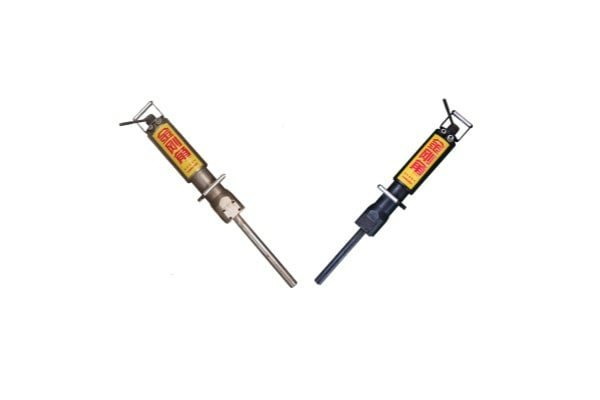
How do rock splitters work?
Breaking hard rock for a project is tough. Traditional methods are often loud, dangerous, or slow, causing major headaches. But what if there was a powerful, precise, and quiet solution?
A rock splitter works by being inserted into a pre-drilled hole. A hydraulic pump then pushes a set of wedges, creating immense splitting force from inside the rock. This controlled power breaks the rock apart along its natural lines of weakness without noise or vibration1.
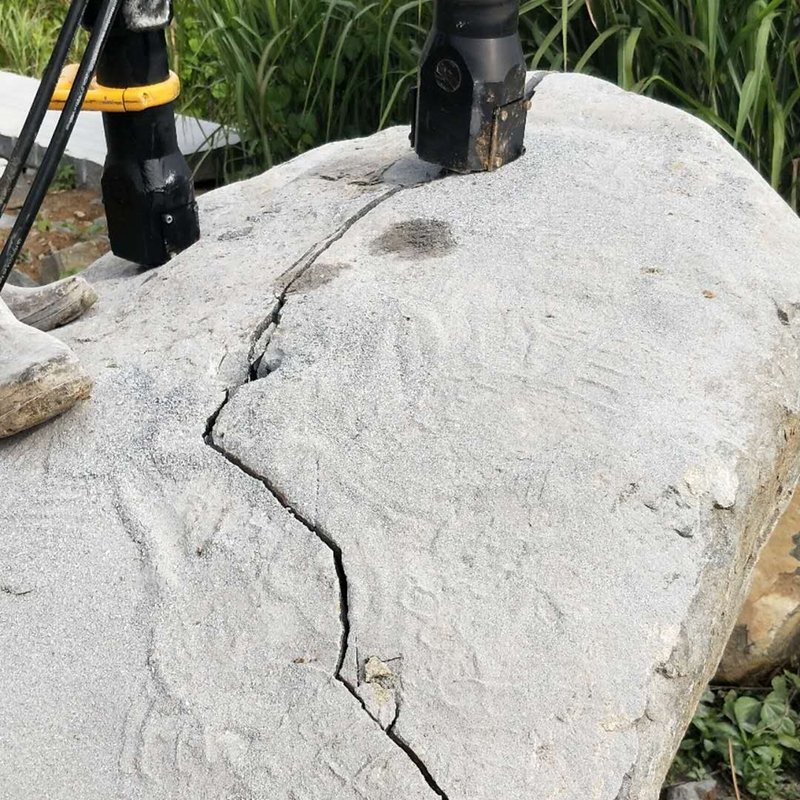 This method seems simple, but it represents a huge leap forward in rock breaking technology. For years, I've seen contractors and mine owners struggle with the old ways of doing things. The constant search for a better method led many of us to this innovative solution. It solves the biggest challenges we face in excavation and demolition. To really understand its impact, we first need to look at the problems it solves. Let's explore why the traditional methods are no longer the best choice for modern projects.
What are the problems with traditional rock breaking methods?
You need to break rock for your project. But using explosives is a regulatory nightmare, and jackhammers are incredibly disruptive. These limitations show why a new approach is so important.
Traditional methods like explosives face strict regulations and cause noise, vibration, and flyrock.2 Hydraulic breakers are also very loud and create disruptive vibrations.3 Chemical expansion agents are slow, inefficient, and highly dependent on weather conditions.4

In my years in this industry, I have seen countless projects get delayed or face community complaints. The reason is almost always related to the rock breaking method. Explosives are the first thing people think of, but getting permits can take months. Even then, you have to deal with safety zones, flyrock risk, and intense vibrations that can damage nearby structures.5 I once consulted on a project that was stalled for six weeks just waiting for a blasting permit.
Then you have hydraulic breakers or jackhammers. They are effective for smaller jobs but create constant, deafening noise and ground vibrations. This isn't just an annoyance; it can lead to work-hour restrictions in urban areas and is completely unsuitable for projects near hospitals or sensitive buildings.
Finally, there are chemical expansive agents. They seem like a quiet alternative, but their performance is a gamble. They need the right temperature to work, and rain can wash them out of the drill holes. Worst of all, they can take several hours, sometimes even a full day, to create a fracture. In a business where time is money, that kind of inefficiency is a deal-breaker.
Comparing Traditional Rock Breaking Methods
| Method | Key Problems | Best Use Case |
|---|---|---|
| Explosives | Strict regulations, safety risks (flyrock), high vibration, noise, dust. | Large-scale, remote mining where disruption is not a concern. |
| Hydraulic Breakers | Extreme noise, significant vibration, limited breaking power for massive rock. | Secondary breaking, smaller demolition jobs, road work. |
| Expansive Agents | Very slow (hours to work), dependent on temperature and weather, inefficient. | Non-urgent situations where noise is a major concern. |
What is the working principle of a hydraulic rock splitter?
You know the old ways of breaking rock are not right for your job. But how can you possibly split a massive boulder without a huge explosion? It's all about using science.
A hydraulic rock splitter uses the wedge principle. A hydraulic pump station pushes a central wedge between two counter-wedges inside a drilled hole. This creates a massive, silent splitting force from within, breaking the rock.
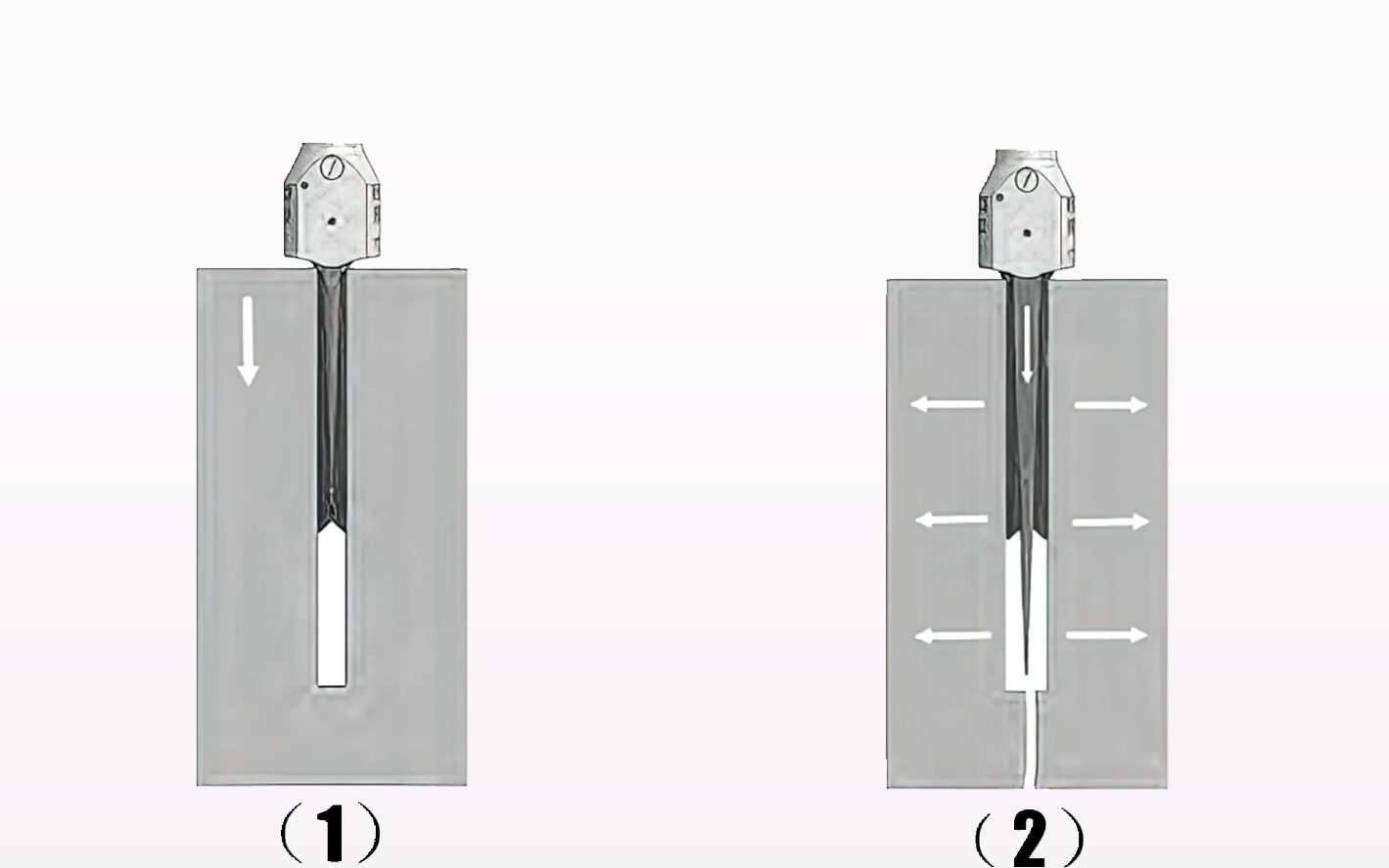
The secret behind the hydraulic rock splitter is simple physics. Rock has very high compressive strength, meaning it's hard to crush from the outside. However, it has very low tensile strength, meaning it's weak when pulled or pushed apart from the inside.6 A rock splitter is designed to exploit this weakness perfectly. I remember the first time I saw one in action on a site. The operator drilled a hole, inserted the tool, and turned on the pump. It was almost silent. A few seconds later, a deep crack appeared, and a huge section of granite just split away. It felt like magic, but it’s just smart engineering.
The process is straightforward and controlled.
Step-by-Step Splitting Process
- Drilling: First, you drill a hole into the rock. The diameter and depth must match the specifications of the splitter you are using. This is the most important step for ensuring the force is applied correctly.
- Insertion: Next, you insert the splitter’s wedge set into the hole. The set consists of a central wedge and two outer counter-wedges.
- Splitting: You then activate the hydraulic pump station. It pumps high-pressure oil that pushes the central wedge forward. This forces the counter-wedges against the walls of the hole, creating a tremendous splitting force of up to 800 tons. Since the force is applied from the inside, the rock has no choice but to give way and crack open. The whole process takes only a few minutes.7
What are the benefits of using a hydraulic rock splitter?
You need an efficient and compliant rock breaking solution. Finding a single tool that is powerful, safe, and easy to use seems almost impossible. A hydraulic rock splitter offers this unique combination.
The main benefits are safety and precision. It produces no flyrock, noise, or vibrations.8 It is also portable, easy to operate, and works in minutes, making it far more efficient than slow chemical agents.
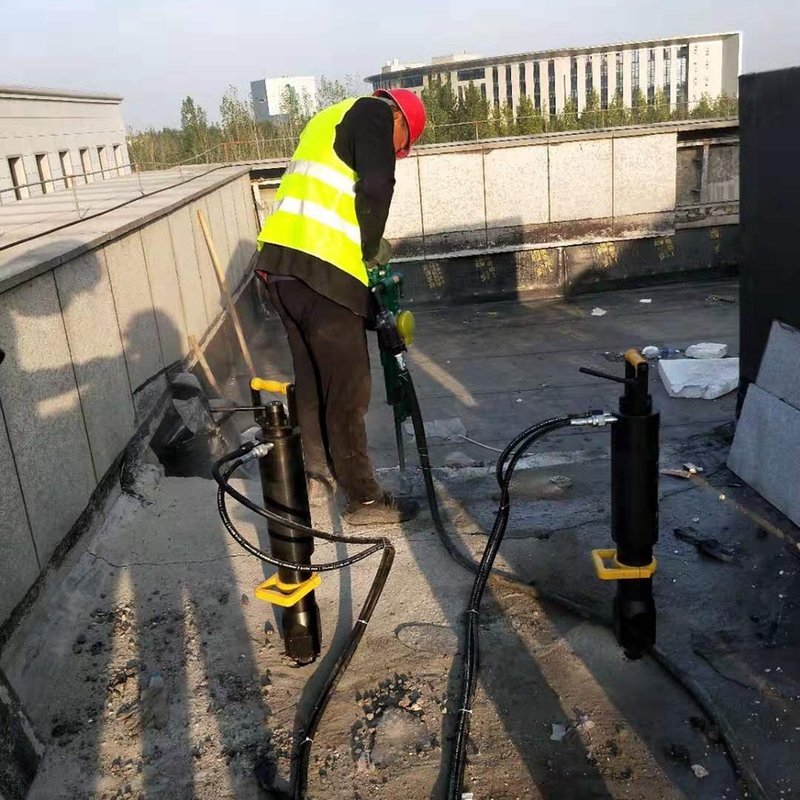
When we started offering hydraulic splitters at Meiger Machinery, our customers were amazed at the difference it made. The benefits go far beyond just breaking rock. They change how projects are planned and executed. For example, a contractor working on a downtown basement expansion was able to work continuously without violating noise ordinances. Another client in a quarry could precisely split blocks of marble without wasting valuable material, which is impossible with explosives. This level of control and versatility opens up new possibilities.
The advantages are clear and address the major pain points of traditional methods.
Key Advantages of Hydraulic Rock Splitters
- Safety First: With no explosions, there is absolutely no flyrock. Workers can stand just a few feet away during operation. This eliminates the need for large safety perimeters and makes the worksite much safer.
- Quiet and Clean: The system is powered by a hydraulic pump and is virtually silent. It also produces no dust or vibrations, making it the perfect choice for sensitive environments like urban areas, hospitals, or inside buildings.
- Unmatched Efficiency: A split is completed in minutes, not hours. Unlike chemical agents, a rock splitter's performance is not affected by rain or temperature.9 This means your project stays on schedule.
- Total Control: You can control the direction of the split. This precision is essential for demolition close to existing structures or for quarrying dimensional stone where you want to preserve the material.
- Incredible Versatility: The equipment is portable and can be operated by a single person. Its small size allows it to be used in tight, confined spaces, for trenching, or even for emergency rescue operations where larger machines cannot go.
As a manufacturer with ISO 9001 and CE certifications, we ensure every splitter is built for durability and performance, so our customers can confidently rely on these benefits.
Conclusion
Hydraulic rock splitters provide a safe, quiet, and powerful way to break rock. They solve the biggest problems of traditional methods, offering a modern and efficient solution for today's engineering projects.
"Is This The Safest Way To Break Stone? This hydraulic rock splitter ...", https://www.instagram.com/reel/DZ5OOPLkt06/. Engineering literature on non-explosive rock excavation identifies hydraulic splitting as a low-vibration and low-noise method relative to blasting and impact breakers. Evidence role: general_support; source type: research. Supports: A research or engineering source should support that hydraulic splitting produces substantially less vibration and noise than blasting or percussive breaking methods.. Scope note: This supports the comparative characterization, but field noise and vibration levels still depend on drilling, pump operation, rock type, and site conditions. ↩
"Mining Topic - Blasting and Explosives - NIOSH - CDC Archive", https://archive.cdc.gov/www_cdc_gov/niosh/mining/topics/Explosives.html. Government blasting-safety guidance identifies flyrock, ground vibration, airblast, and regulatory controls as standard issues in explosive rock excavation. Evidence role: expert_consensus; source type: government. Supports: A government occupational-safety or mining source should document that blasting is regulated and that flyrock, vibration, and noise are recognized hazards.. Scope note: The source would substantiate the general hazards and regulatory context, but not the severity or permitting burden of a particular project. ↩
"[PDF] 9 Construction Equipment Noise Levels and Ranges - Handbook", https://www.nrc.gov/docs/ML1805/ML18059A141.pdf. Occupational-health guidance on construction tools documents high noise and vibration exposure from jackhammers and related percussive breakers. Evidence role: statistic; source type: government. Supports: A government occupational-health source should provide evidence that percussive tools such as jackhammers and breakers can produce hazardous noise and vibration exposure.. Scope note: This supports the general disruption and exposure concern, while actual levels vary by tool, substrate, distance, and duration. ↩
"[PDF] Temperature-related performance factors for chemical demolition ...", https://archive.nyu.edu/bitstream/2451/41688/2/Temperature-related%20performance%20factors%20for%20chemical%20demolition%20agents.pdf. Studies of expansive demolition agents show that their cracking action depends on chemical hydration and expansion, with reaction time and performance influenced by temperature and moisture conditions. Evidence role: mechanism; source type: research. Supports: A research source should explain that expansive demolition agents rely on hydration and expansion reactions whose timing and effectiveness are influenced by temperature and site conditions.. Scope note: This supports the environmental sensitivity and slower mechanism, but the term “inefficient” remains project-dependent. ↩
"[PDF] Blaster's Training Modules - Controlling the Adverse Effects of Blasting", https://www.osmre.gov/sites/default/files/inline-files/Module8.pdf. Blasting-control guidance recognizes flyrock and ground vibration as hazards requiring exclusion zones, monitoring, and limits to reduce risks to people and nearby structures. Evidence role: expert_consensus; source type: government. Supports: A government or standards source should support that blasting design includes exclusion zones and management of flyrock and vibration risks to nearby structures.. Scope note: The source would support the risk category, not prove damage would occur at every site. ↩
"[PDF] Tensile strength of rocks in four-point beam tests", http://earthquakes.ou.edu/reches/Publications/tensile%20strength_1994_B.pdf. Rock-mechanics texts note that rock tensile strength is typically much lower than compressive strength, providing the mechanical basis for splitting methods that induce tensile fracture. Evidence role: mechanism; source type: education. Supports: A rock-mechanics source should confirm that many rocks have tensile strengths far below their compressive strengths, explaining why inducing tensile fracture can split rock effectively.. Scope note: The relationship is general; exact strength ratios vary by lithology, fractures, weathering, and loading conditions. ↩
"A preliminary qualitative evaluation of a hydraulic splitting cylinder ...", https://scielo.org.za/scielo.php?script=sci_arttext&pid=S2225-62532018000800015. Engineering descriptions of hydraulic rock splitting report that the active splitting cycle is short, commonly measured in minutes once the hole has been drilled and the splitter inserted. Evidence role: statistic; source type: research. Supports: A research or engineering field report should support that hydraulic splitting is typically performed in short cycles measured in minutes after drilling and insertion.. Scope note: This supports the active splitting step only; total production time also includes drilling, repositioning, rock removal, and site preparation. ↩
"[PDF] Rock Blasting and Control Overbreak", https://www.fhwa.dot.gov/engineering/geotech/pubs/012844.pdf. Engineering guidance on non-explosive rock breaking describes hydraulic splitting as avoiding explosive flyrock and substantially reducing vibration and noise relative to blasting. Evidence role: general_support; source type: institution. Supports: An engineering institution or construction-safety source should support that hydraulic splitting is a non-explosive method that reduces flyrock, vibration, and noise hazards relative to blasting.. Scope note: The support is comparative; the operation is not literally noiseless because drilling, pumps, and handling equipment may generate sound. ↩
"[PDF] Temperature-related performance factors for chemical demolition ...", https://archive.nyu.edu/bitstream/2451/41688/2/Temperature-related%20performance%20factors%20for%20chemical%20demolition%20agents.pdf. Research on expansive demolition agents reports temperature- and moisture-dependent reaction behavior, whereas hydraulic splitting is a mechanically actuated process driven by hydraulic pressure. Evidence role: general_support; source type: research. Supports: A source should support that chemical expansive agents are sensitive to temperature and water conditions, while hydraulic splitting depends primarily on mechanical hydraulic force.. Scope note: This supports relative weather sensitivity, but extreme weather can still affect equipment handling, drilling, hydraulic fluids, and site safety. ↩