How to operate LOX rock splitting system on site?
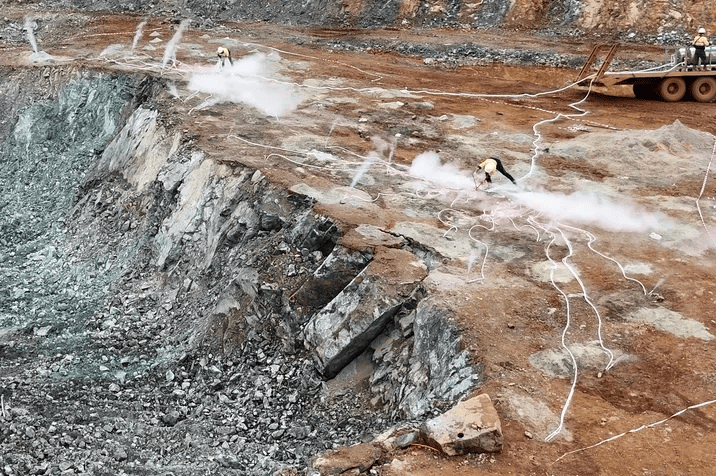
The liquid oxygen rock splitting system is a low-temperature, strongly oxidizing rock-breaking technology. Liquid oxygen remains liquid at -180°C. When heated, it vaporizes rapidly and generates powerful expansion force to break rock mass.
In short,
Firstly,prepare working face.
Secondly,drilling holes.
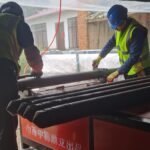
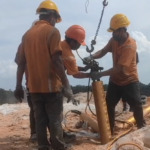
Thirdly,filling pipes.
Forthly,turn on initiator.
Pay attention to
1 Strict oxygen control : Work shall stop immediately once on-site oxygen concentration exceeds 23%.
2 Static protection requirements: Earth lead before filling pipes;
Wear anti-static gloves during filling to prevent static discharge.
3 NO Open flame: Open flame is strictly forbidden within a 50-meter radius.
4 Blasting safety diatance:Safety clearance for fracturing is 50–100 meters.
5 Site rock cleanup:Recommended 20–30 minutes after initiation.
On-site Construction Procedure in details
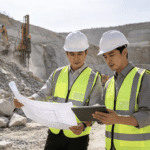
1. Construction Preparation & Site Survey
1). Survey rock mass, adjacent buildings and underground pipelines. Develop a special rock-fracturing plan and define hole spacing, row spacing, hole depth and warning distance.
2). Inspect incoming equipment and materials: Dewar liquid oxygen tank, filling pump, flexible fracturing tubes, initiation controller, ohmmeter, low-temperature frost-proof PPE, dry sand stemming.
3). Clear the working bench, mark warning zones and LOX tank parking area, install warning signs, and remove grease and combustibles from the working zone.
4). Conduct pre-job briefing: assign safety officer, filling operator and initiation operator. Prepare emergency supplies including fire-fighting equipment and frostbite first-aid kits.
2. Drilling Works
1). Drill holes per designed layout with down-the-hole drills or hydraulic drills. Hole diameter, depth and dip angle shall conform to construction drawings.
2). Hole cleaning: blow out rock dust and accumulated water inside boreholes. Inspect hole wall integrity to prevent collapse. Drain holes with excessive water to avoid impaired fracturing performance.
3). Typical reference parameters: hole diameter 90 mm / 110 mm; hole spacing 2.5–3 m, row spacing 2.5–3 m (adjusted according to rock hardness).
3. Fracturing Tube Pre-assembly & Placement into Boreholes
1). Connect filling pipe, exhaust pipe and firing wire to the fracturing tube.
2). Lower the tube slowly into the borehole. Avoid impact or scratches on pipelines. Keep filling pipe, exhaust pipe and initiation wire outside the hole with proper protection.
4. Hole Sealing & Stemming
Backfill and tamp dry fine sand or dry stemming (moisture content ≤3%) in layers to prevent tube ejection. Blast mats may be laid over the hole mouth.
Note: Poor stemming easily causes tube blowout, energy escape and flying rock hazards.
5. Pipe Network & Initiation Circuit Connection, Continuity Test
1). Connect initiation network. Test circuit resistance hole by hole with an ohmmeter to verify good continuity and insulation, free of short or open circuits.
2). Link branch filling pipes of each borehole to the LOX manifold, and connect the Dewar tank to the filling pump.
6. Liquid Oxygen Filling
1). Operators shall wear low-temperature frost-proof gloves and face shield.
2). Open Dewar tank valve and start filling pump to inject liquid oxygen into fracturing tubes. Control filling pressure ≤2.5 MPa. Monitor exhaust pipe status. Close valves once filling meets design requirements, disconnect manifold and retrieve pipelines.
3). Hold a short dwell time for combustible media to fully adsorb liquid oxygen. Liquid oxygen volatilizes quickly; initiate fracturing promptly after filling.
7. Site Evacuation, Warning & Initiation
1). Deploy warning sentries per plan. Minimum open-air safety distance ≥50 m; ≥100 m near residential areas. Evacuate all personnel and machinery to safe zones.
2). Safety officer performs full recheck to confirm complete isolation and no personnel left on site, then reports to the initiation commander.
3). Issue initiation command. The initiation controller triggers fracturing.
8. Post-fracturing Waiting, Inspection & Mucking (Critical Safety Stage)
1). Wait for 20–30 minutes after initiation until dust clears. Only then can a three-person team (technical supervisor, safety officer and operator) enter the site for inspection.
2). Detect on-site oxygen and CO concentrations. Check for leftover tubes, unfired dud tubes and unstable rock.
3). After safety confirmation, remove broken rock mechanically, collect fracturing tube remnants and dispose of them compliantly.
9. Work Completion
Clean the site, recover pipelines and equipment; depressurize and seal Dewar tank. Complete daily construction logs and safety documentation.
Core Safety Guidelines (Mandatory for On-site Staff)
1). Liquid oxygen is strongly oxidizing. It may ignite instantly when contacting grease, carbon powder or fabrics. All tools and gloves must be oil-free.
2). Direct skin contact with liquid oxygen causes severe frostbite. Full low-temperature protective gear is required during filling.
3). In case of leakage, local oxygen concentration rises rapidly. No sparks or static electricity are allowed.
4). Do not carry out blind operations in confined spaces or poorly ventilated tunnels. Continuous oxygen monitoring is required.
5). Never strike or pull dud fracturing tubes. Residual liquid oxygen must be depressurized and drained before handling.